
WASHINGTON 鈥斕鼳pple pie, fireworks 鈥� and the Fifth Dimension?
While it might be difficult to fathom, Independence Day and the 1960s television hit “The Twilight Zone”听have become virtually synonymous in the eyes of the show鈥檚 multigenerational fandom.
For now, the cable network Syfy has been host to an annual July 4听“Twilight Zone“ marathon, and barring rare and widely condemned scheduling snafus 鈥� like the year Syfy decided to run 20 hours of the “over the holiday instead 鈥� this regular event has been elevated to tradition, a ritual even.
One could argue, however, that beyond a Fourth of July staple, “The Twilight Zone“ is as red, white and blue as the annual BBQ and parades, and this is why: The show, which ran for just five seasons from 1960-1964, is, at the very least, a reflection of our nation and people at a crossroads, between a World War and a New Frontier, the conformist 1950s and a counterculture waiting to explode, the comfort of peacetime and the fear of an atomic age. It鈥檚 both a history of our mid-20th century culture, and an X-Ray of humanity.
It is us.听
Aside from pure horror, science fiction and fun 鈥� who doesn’t love the campy young William听Shatner in “,” or the pre-“Kojak“ Telly Savalas in “”听? — the real听zeitgeist听of the era comes听through听every one of the show鈥檚 156 episodes. There is true pathos here, and meaning, thanks to superb writers (among them, creator Rod Serling, Charles Beaumont, Richard Matheson), and actors who acted their guts out with every line.
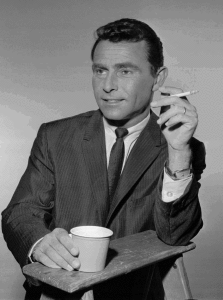
Serling, with trademark cigarette and smirk, served as a memorable guide听whose introductions to each human vignette ranged from ham-handed to moralistic, and always slyly existential. A World War II paratrooper and demolitions specialist who earned a Purple Heart and Bronze Star in the Pacific operations, Serling is a stand-in for his generation and a country on the precipice: he warns of the 鈥渟ignposts ahead,鈥� and there are many.
Among them, five prevailing themes one recognizes time and again over the course of five seasons: nostalgia for the past, conformism and the loss of identity, man’s journey into space, nuclear war and the degradation of humanity.
And we watch, 50 years later, because the tangle of human foibles and dreams, obsessions听and premonitions, still speak to us today.
As a nation at war since 9/11, do we not fear a military brinkmanship that would bring about an end of days, so eerily imagined in several episodes, whether directly ( 听or听““), or metaphorically (““, ““?听As a veteran himself, Serling seemed determined to understand how one side makes the other inhuman in order to annihilate, so jarringly painted in “,” and the once banned-from-syndication, 鈥�,鈥� each exploring the American-Japanese hatred and guilt that animated both sides during and after World War II, not even 20 years before.
After more than 10 years at war in the Middle East, how conditioned are we today to our own prejudices, our fears of 鈥渢he enemy,鈥� here, and abroad?
In Serling鈥檚 post-War time, an era of rapid technological advancement and consumerism archly听depicted in today’s 鈥淢ad Men,鈥� led in part to a yearning for simplicity, a听scaling back of the drive for material successes that seemed less fulfilling with every passing year. could have been a mantra for a generation of men in Gray Flannel Suits. The same goes for when a man momentarily leaves the rat race for a return to his hometown (based on Serling鈥檚 own), and childhood.
In many cases, themes overlap in powerful ways, like in the popular “,” starring Burgess Meredith as a man scorned for reading books and poetry his unsympathetic wife calls 鈥渄oggerel,鈥� hinting at not only a rigid conformism, but a mainstream anti-intellectualism in society that Ray Bradbury eloquently foreshadowed in his own book, 听Farehnheit 451. After a nuclear blast leaves Henry Bemis the last man on earth, it is the books that become both a source of hope and pain. Meredith went on to play the doomed librarian in the equally prophetic, 听too.
We see this again, in “,” a reflection of a real world in which President Kennedy led both the disastrous Bay of Pigs invasion and a more successful Cuban Missile Crisis showdown in the course of two years (1961-62). People all over the country were building bomb shelters for impending doom. But what would happen if only one neighbor had a shelter when the bombs were flying? This episode guesses听at what we鈥檙e all like inside when real fear grips even the most civilized听suburban construct. It boasts one of the most memorial exchanges in the series. After Bill Stockton鈥檚 shelter is destroyed in senseless panic, a neighbor apologizes:
“Oh, we鈥檒l pay for all the damages, Bill,” he says.
Stockton replies: “Damages? I wonder 鈥� if any of us has any idea what those 鈥榙amages鈥� really are. Maybe one of them was finding out what we鈥檙e really like when we鈥檙e 鈥榥ormal.鈥� The kind of people we are, just underneath the skin 鈥� and I mean all of us 鈥� a lot of naked, wild animals who put such a price on staying alive that they鈥檒l claw their own neighbors to death just for the privilege! We were spared a bomb tonight, but I wonder 鈥� if we weren鈥檛 destroyed even without it.”
It鈥檚 a pessimistic view for sure, much like when neighbor turns on neighbor in a fit of controlled paranoia and chaos. Group think, mob mentality, these were the cautionary 鈥渟ignposts鈥� of the era, but do they not still apply today?
Beyond that, we live in a society today that says it values individualism, but听rewards those who look the same, and for that there is a multibillion dollar plastic surgery industry that thrives on the notion that beauty in fact is not in the 听In this regard,听 could鈥檝e been written today.
“The Twilight Zone”听peddles in听human weakness: greed, ego, superstition, vanity, ignorance. Sometimes its hapless characters transcend, other times, they succumb, usually after one terrible lapse in judgment. We know these people 鈥� we see them in the office, in school, during family unions, and oftentimes, in the mirror. We know, watching these episodes 50 years later, they were always there.
In the attached gallery,听submitted for your approval, is a modest sampling of how Serling and his writers told the story of a generation, which we argue still resonates this Independence Day, in “The Twilight Zone.”
听(“The Twilight Zone” marathon beginning at 8 a.m. on Saturday, July 4 with and running through 3 a.m. on July 5)


