
NOTE: This article is Part 1 of a two-part series on George Stevens’ “Giant.”听Click here for Jason’s interview with American Film Institute founder George Stevens Jr.
WASHINGTON — Growing up in San Angelo, Texas, filmmaker听Hector听Gal谩n was well aware of听the Hollywood classic shot in his听home state.听After all, “Giant” (1956) was James Dean’s final movie, co-starring Elizabeth Taylor听and Rock Hudson, and听earned听10 Oscar nominations, including a win for director George Stevens. But as a Latino, he was also aware of the film’s听important听social statement.
“It was really one of the first films — and now of course a classic film — that dealt with these issues of discrimination toward Mexican-Americans,” Gal谩n tells 海角精品黑料. “Growing听up in Texas,听we always knew about the movie.听Our parents would talk about it, and later as we grew, we watched it.”
Now, Gal谩n has returned to his stomping grounds to examine the film’s human rights听legacy in the new听PBS documentary 听which aired Friday听as听the听season opener for “VOCES,” the arts and culture series by Latino Public Broadcasting, and is now available in its entirety .
The 86-minute documentary includes听interviews with the director’s accomplished son, George Stevens Jr., as well as surviving cast members听Earl Holliman and Elsa Cardenas. The latter played听Juana, the Mexican-American woman who marries a young Dennis Hopper,听marking听an interracial marriage 11 years before Sidney Poitier in “Guess Who’s Coming to Dinner” (1967).
“We’ve had several screenings (of the documentary) here in Texas with audiences,”听Gal谩n says, “And everybody that sees it says I’ve gotta go see that movie (‘Giant’)!”
Yes, “Giant” was a different kind of western — like John Ford’s “The Searchers” the same year — in that it grappled with racial prejudice in the Old West. While Ford examined racism toward Native Americans, Stevens examined the听racial divide between Anglos and Latinos.
Such themes made Edna Ferber’s 1952 source novel instantly controversial, yet it was Stevens who made听several key changes to drive the point home. One such change involves the supporting character of Angel (Sal Mineo), an impoverished Mexican-American, aided by Taylor at birth, who later goes off to fight for his country in the U.S. Army.
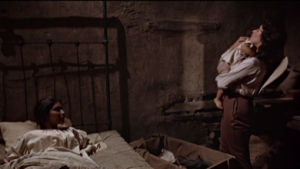
In the book, Angel comes home a听war hero, but in听the movie, he comes home in a coffin.
“I agree with George Stevens by changing it and having him come back in a coffin and buried in a segregated cemetery,” Gal谩n tells 海角精品黑料.听“It just stresses and really shows how these people were sacrificing their lives but yet were being treated as second-class citizens upon their return, even though they were defending America. To me that was a very powerful scene.”
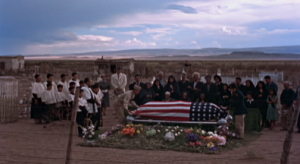
“The blatant discrimination that was occurring at the time against Mexican Americans and African Americans, we’ve overcome a lot of that,”听Gal谩n says. “But even to this day in Marfa, Texas, there’s still a segregated cemetery today. There’s a barbed-wire fence that separates both sides, and there’s a group of people that wants that fence torn down because of what it represents.”
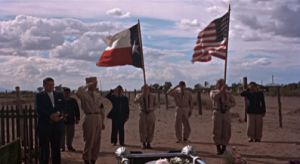
You’ll notice the Texas and American flags are听shown backwards in this symbolic funeral scene:
This is a far cry from the stars-and-bars nostalgically shown throughout听“Gone With the Wind” (1939). Both films beckon instant comparison, as听Reata is Tara re-imagined, with Hudson a sturdy Rhett Butler, Taylor a more听patient听Scarlett O’Hara, and the film’s scope just as massive.听Stevens admitted he hardly noticed the听four-hour length of “GWTW,” saying, 鈥淚 was caught up in it and could have watched even more.鈥� Mercifully, Stevens spared us the “more,” but at three hours and change, “Giant”听was every bit the spectacle, marking Warner Bros.’ most successful film up to that point.
Still,听the title didn’t merely听advertise the spectacle. Its double听meaning was to听correct Tara’s听most glaring flaw 鈥� its pro-slavery听undertones — as Brown vs. The Board of Education听called for the desegregation of schools two years earlier in 1954.听Thus, the title is another way of saying,听鈥渂e the bigger man,鈥� as in being big enough to respect others different from you 鈥� a message ripe for any era.

This growth into a听鈥済iant鈥� is the journey of protagonist Jordan 鈥淏ick鈥� Benedict (Hudson), the owner of Reata, a 600,000-acre Texas cattle ranch passed down for generations. Bick is all about the southern tradition, which听happens to include white males running the show. This irks his听progressive wife from Maryland, Leslie (Taylor), who听adopts certain听positives of the southern lifestyle (鈥淚鈥檓 a tough Texian now鈥�)听but听refuses to give in to the negatives, mocking听sexism听(“Set up my spinning wheel, girls”).
During this journey of man and wife, right and wrong, past and present, the Benedicts struggle against a cocky young handyman, Jett Rink (Dean), who hits a gusher of black gold and uses his “new wealth” to found a rival oil-drilling company. The Benedicts also struggle with how to raise their three children, as听Bick wants his son (Hopper) to take over the ranch, while Leslie encourages his passion of becoming a doctor — and blesses his interracial marriage to a Latina bride (Cardenas).
Stevens masterfully manipulates audience sympathies through the cinematic language. For instance, in the scene where Hudson and Taylor argue over Angel’s medical care, Taylor is shown in a more positive light — literally — with well-lit shots, while Hudson’s reaction shots are听kept in shadows.
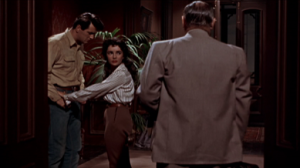
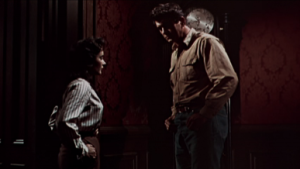
Can Hudson’s character听become the giant his wife wants him to be? Is morality incompatible with his desire to protect a way of life? Ultimately, he听must confront his own beliefs when a Mexican-American family is refused service at a roadside diner, sparking a brawl between Bick and the bigoted owner. As听鈥淵ellow Rose of Texas鈥� plays symbolically on the jukebox, you’ll notice how Stevens pushes in for a final close-up on a sign reading: “We reserve the right to refuse service to anyone.”
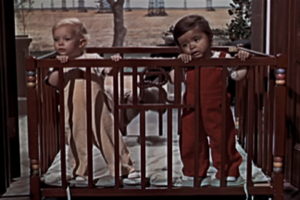
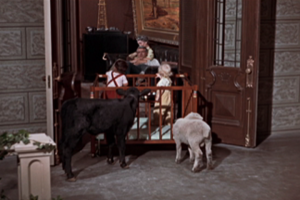
Licking his wounds from the brawl, Hudson is surprised to hear that Taylor is proud of him getting knocked on his behind — because he finally stood up for justice. Together, they stare at their grandchildren — one light-skinned and one brown-skinned — as Stevens symbolically places white and black farm animals behind the playpen. This sort of racial harmony was truly ahead of its time.
For all these genius techniques,听“Giant” made the American Film Institute’s Top 100 Films when the list was first compiled in 1997. Tragically, the movie fell off when the AFI updated the list for its 10th anniversary in 2007. Here’s hoping that — thanks to filmmakers like Gal谩n and dedicated sons like Stevens Jr. — 听this sleeping giant听returns to its rightful place alongside “To Kill a Mockingbird” among the most important American films ever made, boasting a听Stanley Kramer level of听social importance, David Lean level of epic composition and John Ford听level of听symbolic imagery.
In the end, perhaps Stevens’ biggest secret is his decency, that is to say, his ability to criticize听his subject matter, while maintaining a听basic sense of fairness. He makes his points on pressing social issues without alienating the very viewers he’s trying to reach. Throughout, Stevens romanticizes the South for its听gorgeous听landscapes,听hardworking attitudes and horse-riding culture. You don’t leave the film feeling anti-South, but rather believing听there must be a better way.听It shows the possibility of having the best of both worlds: a new open-mindedness to go along with romanticized听tradition.听
Thus, the听film proves what many Southerners have been discovering for years 鈥� that southern pride can break away from a听sinful听past and Dixie can be all the better for it. Modern country music is a testament to this, as we head into the 50th annual ACM Awards. In this light, Kenny Chesney鈥檚 鈥淪ome People Change,鈥� made famous听by听Montgomery Gentry, seems written specifically for听Bick:
His old man was a rebel yeller,
Bad boy to the bone. He鈥檇 say,
鈥淐an鈥檛 trust a color鈥檇 feller,鈥�
He鈥檇 judge 鈥榚m by the tone of their skin.
He was raised to think like his dad,
Narrow mind and full of hate,
On the road to nowhere fast,
Till the grace of God got in the way.
Then he saw the light,
And hit his knees and cried and said a prayer,
Rose up a brand new man, left the old one right there.
Look inward. Do the right thing. Step up and be a giant.
NOTE: This article is Part 1 of a two-part series on George Stevens’ “Giant.”听Click here for Jason’s interview with American Film Institute founder George Stevens Jr.


