
WASHINGTON 鈥� The idea of buying the聽Dulles Greenway with the goal of lowering tolls would require hundreds of millions of dollars in upfront cash, and the chief financial officer of the Virginia Department of Transportation says the purchase would be a bad deal for the state.
Loudoun County lawmakers have lambasted the private road鈥檚 tolls for years, and the Virginia General Assembly in 2013聽directed a review聽to determine聽whether purchasing the road would be a reasonable path forward.
VDOT CFO John Lawson says聽an update of that review聽has again found that it would not be a good deal for the state.
鈥淭he indicative purchase price has gone up [since 2013]; the present value of the future dividends appears to have increased, and the one that really is the biggest issue is that the defeasance cost of the outstanding debt has changed, and while it has gone down some 鈥� the cost to defease the existing debt is the piece that makes this road such an expensive proposition to the Commonwealth,鈥� he told the Commonwealth Transportation Board.
Depending on factors such as what kind of bonds were issued and whether tolls increase, buying the road would cost the state somewhere between about $400 million and $880 million up front. The high-end estimate was $747 million in 2013.
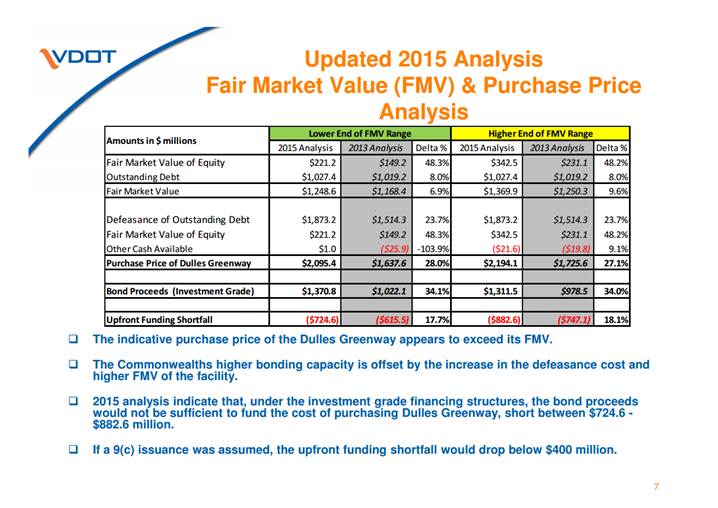
鈥淲hen you come to look at the purchase price, we can鈥檛 just pay off the outstanding debt,鈥� he says.
The $1 billion of debt would actually cost the state around $1.9 billion, because many bondholders are not due to be paid for decades.
鈥淭he outlook today from a purchase perspective from the commonwealth is worse than it would have been in 2013. We are in a worse position to entertain such a purchase, and it certainly would not be my recommendation that we would want to entertain such a purchase,鈥� Lawson says.
Virginia Transportation Secretary Aubrey Layne says the question is academic at the moment anyway, despite the big push from members of the General Assembly and some Loudoun County supervisors.
Layne points out that the owners, Toll Road Investors Partnership II, would have to want to sell the road, and he says they are not in a financial position where they would have to.
Layne聽emphasizes that the state is bound by contracts with the road鈥檚 operators that were agreed to as part of the original public-private concession agreement. But he argues that, despite the road鈥檚 owners鈥� claims that they have not made a profit, money has been paid to investors.
鈥淚f you look at the original capitalization of the deal, that is the amount of borrowing and equity, and then what it is today versus the purchase price plus the improvements, it鈥檚 pretty obvious they鈥檝e been able to pull a bunch of money out that they haven鈥檛 actually put back into the road, just like I used to do when I was in the real estate business, except I didn鈥檛 have the taxpayers,鈥� Layne says.
State law allows tolls to rise each year through 2020 at a rate tied to inflation, while further increases are regulated by the State Corporation Commission.
Loudoun County is聽appealing a rate case聽from the commission to Virginia鈥檚 Supreme Court.
Commonwealth Transportation Board member William Fralin, of Roanoke, says that the push to buy the Greenway is an example of the political risk that always needs to be factored into private-public partnership agreements.
鈥淭his is one of the things we looked at when we were evaluating the concession agreements in general: You have to protect against political risk. This is what you鈥檙e experiencing right now 鈥� somebody鈥檚 got some upset constituents because they think they鈥檙e paying too much in tolls and they look to聽us to relieve that, and I think the analysis is pretty clear that that鈥檚 not a good deal for the state,鈥� he says.
Read the report:


